

IFRS 18 is approaching, and finance teams need more than a redesigned reporting template. A controlled transition connects presentation decisions to reliable data, documented judgements and clear ownership. This guide explains the main changes and a practical route to readiness.
What changes from IAS 1, and who is affected?
IFRS 18 Presentation and Disclosure in Financial Statements replaces IAS 1, with some former IAS 1 requirements moved to other Standards. Its central changes concern presentation and disclosure, rather than remeasurement or the creation of economic profit. [1, 2]
It applies to entities reporting under full IFRS Accounting Standards as endorsed in Saudi Arabia. An entity using the IFRS for SMEs Accounting Standard does not automatically apply IFRS 18 simply because 2027 has arrived: first establish the applicable reporting framework. [1, 3]
IFRS 18 effective date and comparative information
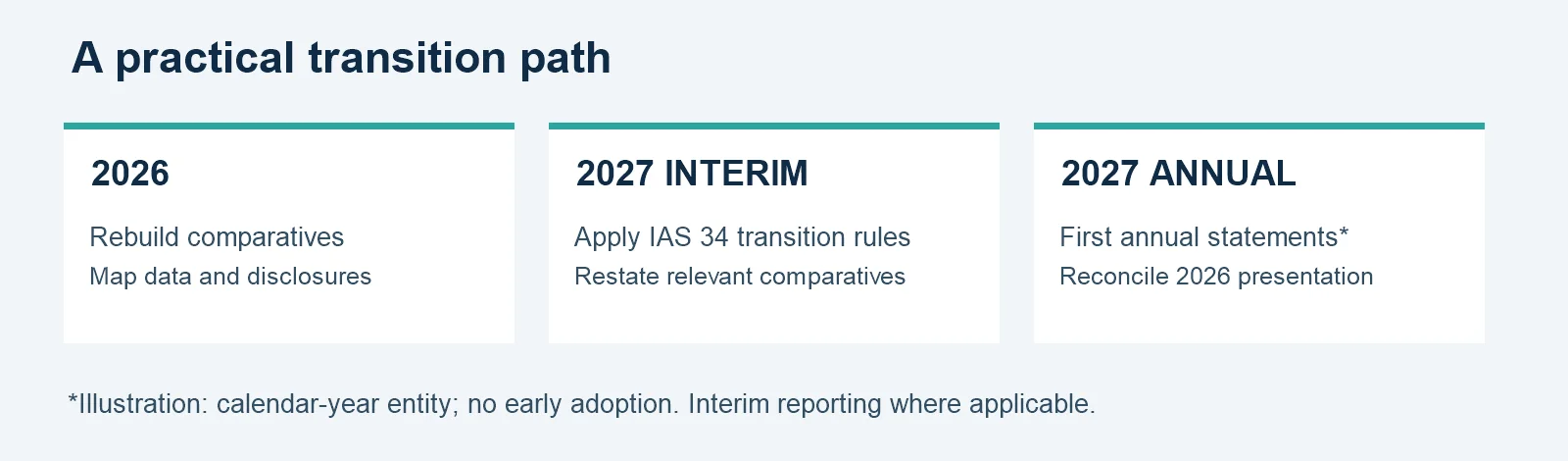
Mandatory application is for annual periods beginning on or after 1 January 2027, with earlier application permitted subject to local requirements. Application is retrospective. A calendar-year entity first applying in 2027 restates its 2026 comparatives and provides the required transition reconciliations. For a 1 July year start, the first mandatory annual period begins on 1 July 2027. [1]
A Saudi listed-company consideration
The CMA requires approved 2026 statements to remain on IAS 1, while permitting an additional IFRS 18 early-adoption announcement. A preliminary expected-impact assessment is required in interim and annual statements for periods beginning on or after 1 April 2026. [4]
A clearer income statement
Five categories of income and expenses
| Category | Core idea |
|---|---|
| Operating | The residual category; it is not restricted to recurring items. |
| Investing | Returns and expenses from specified assets, subject to the rules. |
| Financing | Income and expenses from specified liabilities. |
| Zakat and income taxes | Saudi-endorsed terminology and local requirements apply. |
| Discontinued operations | Presented under the relevant IFRS 5 requirements. |
IFRS 18 highlights operating profit and profit before financing and income taxes; the Saudi-endorsed version incorporates Zakat in the latter subtotal. Specific exceptions apply. Investing in assets or financing customers as a main business activity can change classification, so an industrial-company template should not be copied to a bank or investment business without analysis. [1, 3, 5]
Illustration: industrial entity — SAR million
| Line item | Amount |
|---|---|
| Revenue | 100 |
| Cost of sales | (60) |
| Gross profit | 40 |
| Other operating expenses, net | (20) |
| Operating profit | 20 |
| Investing income: deposit return | 2 |
| Profit before financing, Zakat and income taxes | 22 |
| Financing expenses | (4) |
| Profit before Zakat and income taxes | 18 |
| Zakat and income taxes | (3) |
| Profit from continuing operations | 15 |
Assumptions: investing and customer financing are not main business activities; there are no discontinued operations. Zakat and tax are illustrative amounts, not a tax-base calculation. This is an educational summary, not a complete financial statement template.
Practical implication: reclassification can change reported operating profit while total profit remains unchanged when the impact is presentation-only. Explain the bridge clearly to stakeholders. [2]
Management measures and better disclosures
Which measures are MPMs?
Not every KPI is a management-defined performance measure. An MPM is a subtotal of income and expenses used in public communications outside the statements to convey management’s view of an aspect of the entity-wide financial performance, excluding specified or IFRS-required subtotals. An EBITDA label alone does not settle the assessment; ratios and cash-flow measures are not themselves MPMs. [5]
Qualifying measures are explained together in one note, including their calculation, usefulness, reconciliation to the most directly comparable IFRS total or subtotal, and the income-tax and non-controlling-interest effects of each reconciling item. [6]
Illustration: adjusted operating profit bridge
| Line item — SAR million | Amount |
|---|---|
| IFRS operating profit | 20 |
| Add back: restructuring expense excluded by management | 3 |
| Adjusted operating profit — if the MPM definition is met | 23 |
Complete disclosures explain the adjustment, affected statement line, calculation and tax and non-controlling-interest effects. Excluding a cost from an MPM does not remove it from IFRS profit or loss. This bridge is not a complete MPM note. [6]
Aggregation, disaggregation and expenses
Group items with shared characteristics and separate dissimilar items without obscuring material information under “other”. Expense presentation by nature, function or a suitable combination depends on the most useful structured summary. [2]
Presenting any operating expense line by function triggers specified nature disclosures covering depreciation, amortisation, employee benefits, impairment and inventory write-downs, including applicable reversals. The 2026 implementation guidance confirms no general exclusion for functional line items required by other Standards. [7]
Consequential cash-flow changes
IAS 7 amendments use operating profit as the starting point for the indirect method and introduce new interest and dividend cash-flow classification rules. Analyse cash flows separately: income-statement categories are not automatically identical to cash-flow classifications. [8]
A practical IFRS 18 readiness roadmap
The following is a suggested delivery plan, not a regulator-prescribed timetable:
| Phase | Management deliverable |
|---|---|
| Scope and gap assessment | Applicable framework, main-activity judgements and priorities. |
| Classification design | Account mapping and documented classification decisions. |
| Comparative preparation | Restated 2026 data, transition bridges and supporting evidence. |
| Management measures | Public-measure inventory, definition assessment and draft note. |
| Systems and controls | Revised templates, data testing and review responsibilities. |
| Dry run and approval | Trial close, issue resolution, training and governance reporting. |
Assign an owner to each data requirement and judgement, maintain a decision log and engage the auditor early on significant issues. These are operational recommendations; project effort depends on the entity’s complexity. [9]
Frequently asked questions
Is IFRS 18 only for listed companies?
No. The reporting framework determines the scope, which can include unlisted full-IFRS reporters. [1]
Must 2026 be restated?
Yes, as the comparative year for a calendar-year entity first applying in 2027, with the required reconciliations. [1]
Are all non-recurring expenses outside operating profit?
No. Apply the classification requirements rather than an “exceptional” label. [1]
Is updating an Excel template enough?
Data sources, controls and disclosure approvals may also need changes. [9]
Discuss your readiness with Future Expertise CPAs
Contact Future Expertise CPAs to discuss a readiness assessment, presentation and disclosure gap analysis, account mapping, comparative preparation and technical workshops. Scope is agreed after needs assessment and engagement acceptance, subject to professional independence requirements. Management retains responsibility for decisions and preparation of the financial statements.
Start with our financial consulting team. Useful inputs include the latest financial statements, trial balance, chart of accounts, investor presentations and publicly reported performance measures.
Sources
- 1. IFRS Foundation — IFRS 18 issued Standard (2025 edition). Scope, categories, exceptions and Appendix C transition.
- 2. IFRS Foundation — Project Summary, April 2024. Presentation, disclosure and aggregation overview.
- 3. SOCPA — Endorsement document, revised 24 December 2025; IFRS 18 section. Includes Saudi Zakat additions.
- 4. Capital Market Authority — IFRS 18 early-adoption announcement, 30 June 2026.
- 5. IFRS Foundation — IFRS 18 key terms. Definitions and specified main business activities.
- 6. IFRS Foundation — IFRS Accounting Taxonomy update 2025-1. MPM disclosure and reconciliation explanation.
- 7. IFRS Foundation — IFRIC Update March 2026; expense-by-nature agenda decision published April 2026.
- 8. IFRS Foundation — IAS 7 standard page; history of consequential IFRS 18 amendments.
- 9. IFRS Foundation — Effects Analysis, April 2024. Implementation data and systems considerations; roadmap is our editorial recommendation.
